
How to Build a Small Business Marketing Plan That Actually Works: 10-Step Guide
How to Build a Small Business Marketing Plan That Actually Works: 10-Step Guide
Every successful business, regardless of size or budget, runs on a small business marketing plan. Without one, you’re not marketing — you’re guessing. You’re posting without purpose, spending without direction, and measuring without benchmarks.
A good marketing strategy doesn’t have to be a 40-page document. In fact, the most effective plans are focused, flexible, and built around real data. Whether you’re launching a new venture or refreshing an existing one, this 10-step guide will walk you through every component of a plan that generates measurable results.
Step 1: Conduct a Situational Analysis (Know Where You Stand)
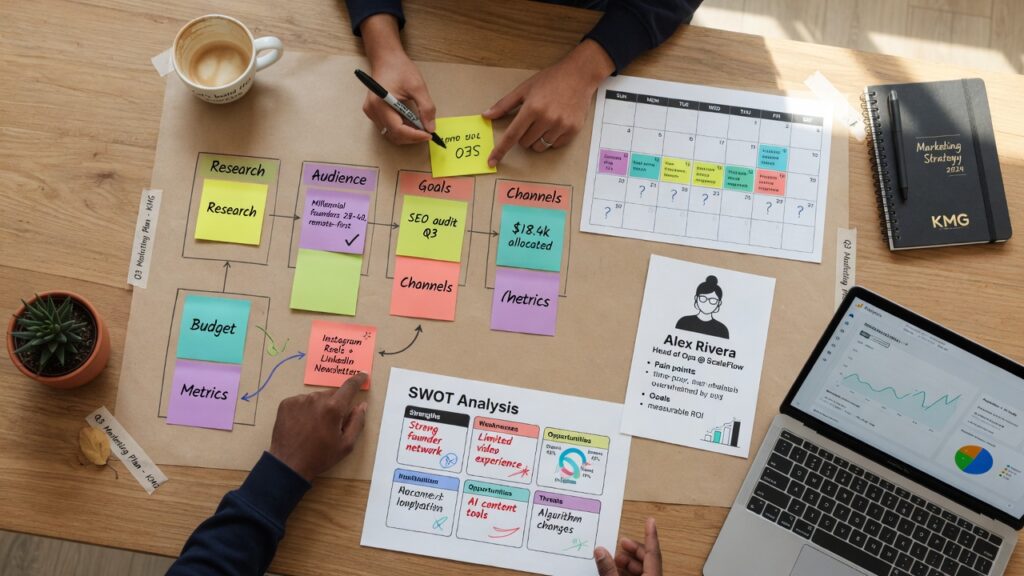
Before you plan where you’re going, you need an honest picture of where you are. The most effective framework for this is a SWOT analysis — an assessment of your business’s Strengths, Weaknesses, Opportunities, and Threats.
Your Strengths are internal advantages: your experience, your location, your loyal customers, your pricing, your team. Your Weaknesses are internal gaps: limited budget, thin online presence, staff turnover, inconsistent branding. Opportunities are external conditions working in your favor: growing local demand, a competitor closing, an underserved niche. Threats are external forces that could hurt you: new competitors, economic shifts, platform algorithm changes, supply chain issues.
Be brutally honest here. The SWOT analysis is the foundation everything else builds on.
Also gather hard data at this stage: your current sales volume and seasonal patterns, your website traffic and conversion rates, your customer acquisition costs, and your best-performing existing marketing channels.
Step 2: Define Your Target Audience (Build a Buyer Persona)
Vague targeting produces vague results. Your small business marketing plan needs to define exactly who you’re selling to — not just “adults 25–54” but a specific, researched profile of your ideal customer.
Build at least one buyer persona: a semi-fictional representation of your best customer based on real data. Include demographics (age, gender, income, location), psychographics (values, lifestyle, goals, pain points), buying behavior (how they research, where they shop, what triggers a purchase), and preferred communication channels (email, Instagram, Google search, word of mouth).
The more specifically you can describe your ideal customer, the more precisely you can reach them — and the less you waste on people who will never buy.
Step 3: Define Your Unique Value Proposition
Before you can market effectively, you need to answer one question with brutal clarity: Why should someone choose you over every other option?
Your Unique Value Proposition (UVP) is a single, compelling statement that answers that question. It’s not your tagline. It’s the core promise that drives every message, every campaign, and every piece of content you produce.
A strong UVP is specific (“The only full-service digital agency in the Rio Grande Valley with 29 years of local business expertise”), not generic (“We provide quality service at competitive prices”). Generic UVPs are invisible. Specific ones stick.
Step 4: Analyze Your Competition
List your direct competitors. For each one, identify their strengths and weaknesses from your customer’s perspective — not your ego’s. Look at their pricing, their digital presence, their Google reviews, their social media activity, their website quality, and the messaging they use.
The goal isn’t to copy them — it’s to find the gaps they’re leaving open. Where are they weak? What are their customers complaining about in reviews? What audiences are they ignoring? Those gaps are your opportunities.
Step 5: Set SMART Goals
One of the most common failures in a small business marketing plan is setting goals that are too vague to measure. “Get more customers” is not a goal. It’s a wish.
Every goal in your plan should be SMART: Specific, Measurable, Achievable, Relevant, and Time-bound.
Instead of “increase website traffic,” write: “Increase organic website traffic by 25% within 6 months by publishing two SEO-optimized blog posts per month.” Instead of “grow on social media,” write: “Grow Instagram following from 400 to 800 by Q3 through weekly Reels and a monthly giveaway campaign.”
SMART goals give you clarity on what success looks like — and make it impossible to rationalize mediocre results.
Step 6: Choose Your Marketing Channels Strategically
Not every channel works for every business. Your channel selection should follow your audience — go where your customers already are, not where marketing trends tell you to be.
Your marketing strategy in 2026 should account for both owned and rented channels:
Owned channels are assets you control: your website, your email list, your blog, and your Google Business Profile. These should form the core of your plan. For direct-to-consumer businesses, email marketing has consistently delivered the highest ROI of any marketing channel, according to HubSpot’s 2025 State of Marketing Report. Shopify Your email list is yours — no algorithm can throttle it.
Rented channels are platforms you don’t control: Facebook, Instagram, TikTok, Google Ads. These are powerful amplifiers, but the rules can change overnight. Use them to drive traffic back to your owned assets.
Channels to evaluate for your plan:
Your website and SEO should be the centerpiece. It works around the clock, belongs to you, and compounds over time. Every blog post, every service page, every review you earn builds authority.
Google Business Profile is non-negotiable for any local business. It’s free, it drives foot traffic and calls, and it directly impacts your visibility in local search.
Email marketing is your highest-ROI channel for nurturing leads and retaining existing customers. Build your list aggressively — every customer interaction is an opportunity to capture an email address.
Paid advertising (Google Ads, Meta Ads) can drive immediate results but requires ongoing investment and optimization. Set a clear cost-per-acquisition target before you spend.
Social media works best for community-building and brand awareness, not organic reach. Choose one or two platforms and commit to them consistently rather than spreading thin across five.
Content marketing (blog posts, videos, guides) builds long-term authority and feeds every other channel. Businesses that lean into trusted channels and communicate with purpose — rather than chasing every new trend — are the ones outpacing competitors in 2026. Americanmarketer
Step 7: Establish Your Brand Standards
Inconsistent branding is invisible branding. Your small business marketing plan must define and lock in your brand standards before any campaign launches.
This includes your logo and its proper usage, your color palette (primary and secondary colors with hex codes), your typography (headline and body fonts), your brand voice (professional, conversational, bold, warm — pick a lane and stay in it), and your photography style.
These standards must be documented and applied consistently across your website, social media, print materials, signage, and advertising. Consistency is what transforms a business into a brand.
Step 8: Set Your Marketing Budget
Most small businesses should allocate 5–10% of revenue to marketing. Newer businesses or those in growth mode may invest 10–20%. The key is tracking return on investment — spending $5,000 per month that generates $25,000 in revenue is far better than spending $500 that generates nothing. SDO CPA LLC
Once you know your total budget, allocate it across your chosen channels based on expected ROI. A practical starting framework:
Prioritize your website and SEO first — this is your long-term foundation. Allocate a portion to paid advertising for immediate lead generation. Reserve budget for email marketing tools and content creation. Keep a small percentage (around 10–20%) for testing new channels or formats.
Identify which elements you can handle in-house and which require outside expertise. Outsourcing strategy, design, and technical SEO to professionals while managing community engagement yourself is a smart division for most small businesses.
Step 9: Define Your KPIs and Measurement Framework
The difference between a marketing strategy that improves and one that stagnates is measurement. Before you launch any campaign, define exactly how you’ll know if it’s working.
Establish the difference between vanity metrics (likes, followers, impressions) and performance metrics (leads generated, cost per acquisition, email open rates, conversion rates, revenue attributed to each channel). Vanity metrics feel good. Performance metrics tell the truth.
Set up Google Analytics 4 on your website, connect Google Search Console, and build a simple monthly reporting dashboard. Track your top three to five KPIs consistently — not every possible data point, just the ones tied directly to your SMART goals.
Review performance monthly. Reallocate budget away from underperforming channels toward what’s working. This is not a “set it and forget it” plan.
Step 10: Build a Retention Strategy (Your Most Overlooked Channel)
Most small business marketing plans focus entirely on customer acquisition and neglect the highest-ROI marketing activity available: keeping the customers you already have.
Seventy-two percent of customers return to the same small businesses each season, and 88% say they’re likely to become repeat buyers after a positive experience. In 2026, retention is a small business’s most predictable growth engine. Americanmarketer
Your retention strategy should include a post-purchase follow-up sequence (email), a loyalty or referral program, consistent re-engagement through your email list and social content, and a system for collecting and responding to reviews. A customer who comes back twice is worth exponentially more than two separate one-time customers.
Review, Revise, Repeat
A small business marketing plan is a living document, not a one-time exercise. Successful marketers review their plans quarterly, measure results against their SMART goals, and adapt to what the data tells them. The channels, budgets, and tactics that worked last year may not be the right allocation for next year.
Build the habit of reviewing your plan — not just your results — on a regular schedule.
If you need help building a marketing strategy that’s grounded in data, tailored to the Rio Grande Valley market, and built around assets you actually own, Kennedy Media Group has been doing exactly that for local businesses since 1997. Let’s build your plan together.