
How to Run a Social Media Giveaway: 5 Rules + Texas Legal Guide
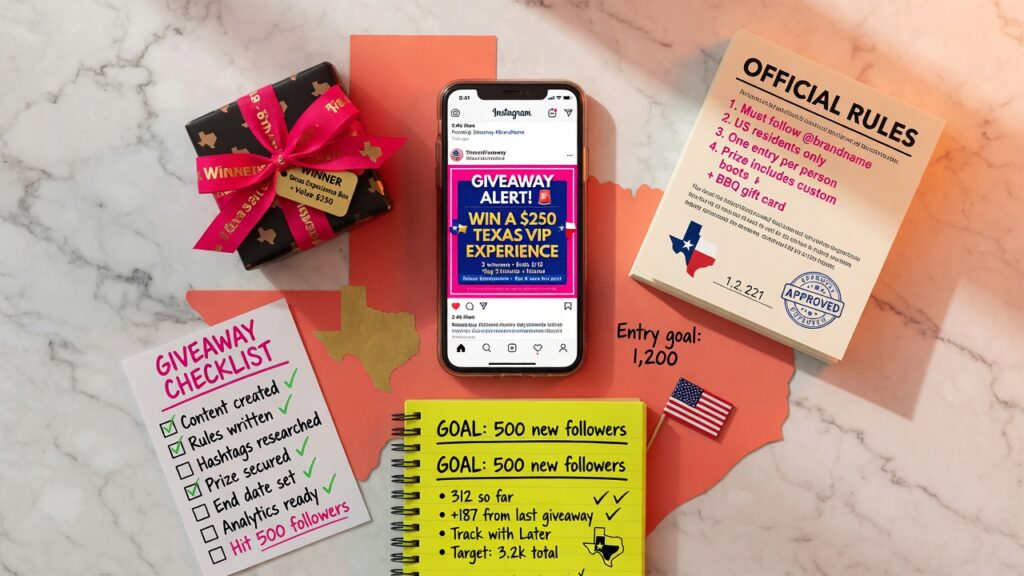
How to Run a Social Media Giveaway: 5 Rules + What Texas Law Requires
Running a social media giveaway is one of the fastest ways to grow your audience, generate buzz, and reward your customers. Done right, an online contest can produce thousands of impressions, hundreds of new followers, and real leads — all without a paid ad budget.
But done wrong, it can expose your business to legal risk. Texas has specific laws governing contests, giveaways, and sweepstakes — and most business owners have no idea they exist.
This guide covers both: the 5 strategic rules for running a successful social media giveaway, and what Texas law actually requires before you launch.
Rule #1: Define Your Goal Before You Design the Contest
Every successful social media giveaway starts with a single, measurable goal. Are you trying to grow your Facebook following? Generate email leads? Drive traffic to your website? Reward existing customers? The mechanics of your contest — how people enter, what they win, how long it runs — should all serve that one goal.
A giveaway without a goal is just noise. A giveaway with a clear goal is a campaign.
Rule #2: Choose the Right Prize for Your Audience
The prize is what drives participation. Generic prizes like cash or gift cards attract everyone — including people who will never become customers. The best online contest prizes are things your ideal customer actually wants: your product, your service, an experience tied to your brand, or something highly relevant to your niche.
The more targeted the prize, the more targeted your entries — and the higher your post-contest conversion rate.
Rule #3: Make Entry Simple and Platform-Native
Complicated entry processes kill participation. The best-performing social media giveaway formats on Facebook and Instagram are frictionless: like the post, tag a friend, follow the page, share to your story. Each of these actions also amplifies organic reach, turning your contestants into your promoters.
Keep the entry steps to two or three maximum. Every extra step you add cuts your entry rate.
Rule #4: Publish Clear Official Rules — Every Single Time
This isn’t optional, and it’s not just about optics — it’s a legal requirement. Your giveaway rules must clearly state the start and end dates, how winners will be selected and notified, prize details and approximate retail value, eligibility requirements (age, location), and a “No Purchase Necessary” declaration for sweepstakes-style promotions.
Post the rules directly in the caption or link to a dedicated rules page. Platforms like Facebook and Instagram also require you to include a disclaimer that the promotion is not sponsored by, endorsed by, or affiliated with the platform.
Rule #5: Follow Through With a Public Winner Announcement
The most overlooked step in running an online contest is the winner reveal. Announcing your winner publicly — on the same platform where you ran the giveaway — builds trust, validates the contest’s legitimacy, and gives you one more piece of engaging content. It also closes the loop for everyone who entered and didn’t win, making them more likely to participate next time.
Document everything: screenshots of your winner selection, DMs, and confirmation of prize delivery.
⚖️ Texas Law: What Every Business Owner Needs to Know Before Running a Giveaway
This is the part most marketing guides skip — and it’s the part that matters most if your business operates in Texas.
Contests vs. Sweepstakes vs. Raffles — They’re Not the Same Thing
Texas law treats these three promotion types very differently:
A sweepstakes awards prizes based on chance. No purchase can be required to enter. This is the most common format for social media giveaways — “like and tag to win” — and it’s fully legal for any Texas business as long as entry is free.
A contest awards prizes based on skill or merit — photo contests, caption competitions, recipe submissions. In Texas, an entry fee or purchase can be required for a skill-based contest without needing a free alternate entry method, unlike sweepstakes.
A raffle requires participants to purchase a ticket for a chance to win. In Texas, only qualified nonprofit organizations are permitted to hold raffles — individuals and for-profit businesses are not. Raffles For Less Under the Charitable Raffle Enabling Act, qualifying nonprofits must have existed in Texas for at least three years. Raffles For Less If your business is for-profit and you’re charging for entries, you’re running an illegal lottery — not a raffle.
The Three-Part Lottery Test
To avoid running an illegal lottery, your promotion must eliminate at least one of three elements: prize, consideration (payment/purchase), and chance. Business.com A standard social media giveaway eliminates consideration by making entry free — that’s what keeps it legal.
A sweepstakes is legal as long as there is no purchase required for participation; if a purchase or significant effort is involved, a free alternate method of entry must also be present. Nationalsweepstakescompany
Texas-Specific Rules Under the Contest and Gift Giveaway Act
Texas Business & Commerce Code Chapter 621 — the Contest and Gift Giveaway Act — governs how businesses must operate contests and gift promotions in the state. Texas State Law Library Key requirements include:
Disclose the odds. For drawings, you must clearly disclose the odds of winning each prize, the exact prizes to be awarded, and the beginning and ending dates of the contest period. Justia If the total number of entries isn’t known, state that odds depend on entries received.
Don’t mislead participants. Texas law prohibits using terms like “finalist,” “winner,” or “grand prize recipient” in a false or misleading way, or representing that a person has won or will win when that isn’t true. Findlaw
You must award the prize. If a major prize is not claimed during the contest period, the offeror must conduct a drawing no later than 60 days after the contest period ends, and every promised prize must be awarded. Justia
Keep records. For contests other than drawings, businesses must maintain records — including identity of those who ran the promotion, prize winner lists, and supporting documentation — until the second anniversary of the date the last prize was awarded. Texas.Public.Law
Prize conditioning is prohibited. An offeror may not notify a person that they’ve won a prize if receipt of that prize is conditioned on purchasing a good or service unrelated to the prize. Justia
For Sweepstakes with Prizes Over $50,000
In Texas, any sweepstakes with a prize valued over $50,000 is prohibited from automatically entering consumers into the promotion when purchases are made. Rtm For most small business giveaways, this threshold won’t apply — but if you’re running a major promotion, it’s a line you need to know about.
Federal Rules Apply Too
Beyond Texas law, federal rules from the FTC govern all promotional contests nationwide. Winners receiving prizes valued over $600 must receive a 1099 tax form and report the value as miscellaneous income. Prize values must be disclosed as ARV (Approximate Retail Value). And all promotions must be honest and non-deceptive under FTC consumer protection guidelines.
A Note on Platform Rules
Facebook and Instagram both have their own promotional guidelines that run alongside the law. Both platforms require you to acknowledge that they are not sponsors and have no involvement in the promotion. Always include this disclaimer in your post or official rules.
The bottom line: A well-run social media giveaway can do tremendous things for your brand. But it needs to be built on a solid legal foundation. When in doubt, consult a Texas-licensed attorney before launching — especially if prizes are significant, entry mechanics are complex, or you’re unsure whether your promotion crosses into raffle territory.
At Kennedy Media Group, we help Rio Grande Valley businesses plan and execute social media giveaways and digital marketing campaigns that are both effective and compliant. Let’s build your next campaign together.
Disclaimer: This article is for informational purposes only and does not constitute legal advice. Laws can change. Consult a licensed Texas attorney before running any promotional contest or giveaway.