
Facebook Marketing for Small Business: The Organic Reach Truth in 2026
Facebook Marketing for Small Business: The Organic Reach Truth in 2026
I’ve been building and managing websites and marketing campaigns for small and mid-size businesses across the Rio Grande Valley for nearly 30 years. One thing has remained constant in almost every client kickoff meeting: someone asks about their Facebook Page.
It’s the expected item on every digital marketing checklist. Set it up, get likes, post content, watch customers roll in. It sounds brilliant. And for a long time, it was the conventional wisdom.
But the reality of Facebook marketing for small business is more complicated — and more expensive — than most business owners realize. Let me break it down.
The Promise: Organic Reach
The fundamental pitch behind a Facebook Business Page is called organic reach — the idea that when you post something, the people who’ve “liked” your page will see it in their feed for free. You build an audience, you post to that audience, and your marketing message gets out.
This is what almost every small business owner believes when they invest time and money into growing their Facebook following.
It sounds wonderful. And it used to work.
The Reality: You’re Paying Twice
Here’s where Facebook marketing for small business breaks down in practice.
You invest money — either through boosted posts or Facebook ads — to get people to like your page. This feels like building a subscriber list, a database of people interested in your brand. It feels justified.
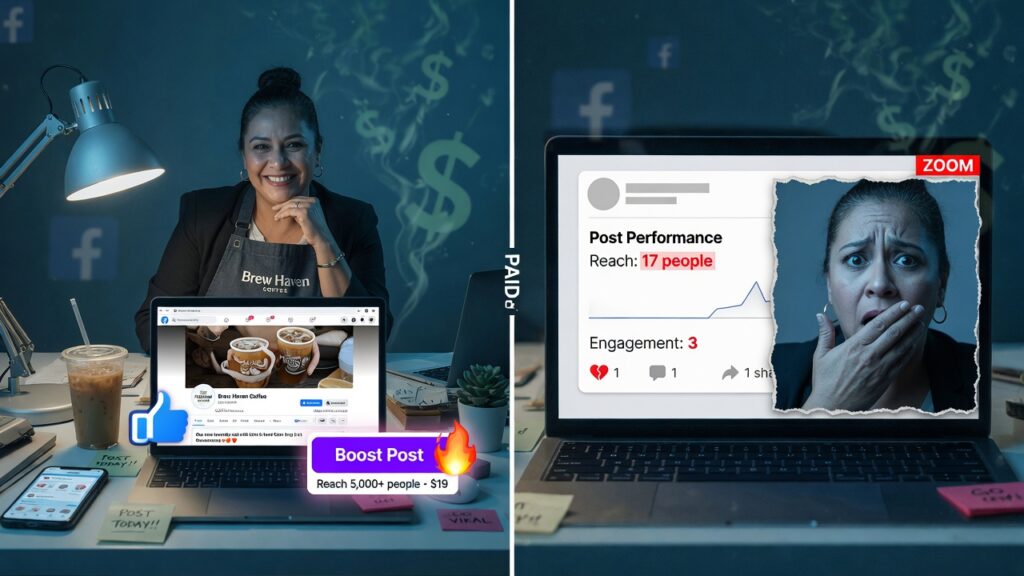
Then you create great content. Your designer works up a polished graphic. You write a compelling post. You hit publish. And then… almost nobody sees it.
Facebook’s organic reach across 2024 measured just 1.37%, with a median engagement rate of 0.2%. Keefomatic That means if you have 500 followers, roughly 7 of them will see your post. Organically.
To put that in plain terms: it’s like building an email list of 500 people and your email system randomly sending to only 7 of them. You’d fire your email provider. But with Facebook, people just keep boosting posts.
So now you have two costs: paying to build the audience, and then paying again to reach the audience you already paid to build. Facebook is an advertising company first and foremost, and it has a vested interest in making organic reach more difficult in order to compel brands to pay to promote their posts. Marketing Scoop
How Did We Get Here?
This wasn’t always the case. Back in 2012, Facebook’s average organic reach was a healthy 16%. By 2025, it hovered between 1–2%. Hootsuite Blog The decline has been steady and intentional.
In January 2018, Facebook made a monumental change to its News Feed algorithm, announcing it would prioritize “meaningful social interactions” and show more posts from friends and family over brands and publishers. Organic reach for Pages dropped 35% on average in the wake of this single change. Marketing Scoop
The algorithm now decides what gets seen based on engagement signals — time spent, comments, shares, reactions. If your first few exposures don’t generate interaction, the post stops spreading. A skilled marketer who understands timing, content format, and audience psychology can nudge those numbers upward. But most small businesses aren’t running optimized social strategies — they’re just posting announcements into the void.
So Is Facebook Useless for Small Business?
Not entirely — but the role has fundamentally changed, and understanding that shift is critical to not wasting your budget.
Where Facebook still has real value for small businesses:
As a credibility signal. Your Facebook Page is often the first place a potential customer checks after hearing your name. An active, well-maintained page with reviews, photos, and recent posts builds trust. An abandoned page does the opposite. Think of it as a digital storefront window — people look before they walk in.
As the gateway to Meta’s ad platform. You cannot run ads on Facebook or Instagram without a Facebook Business Page. 12amagency Meta’s paid advertising ecosystem — with its hyper-specific demographic, behavioral, and geographic targeting — is genuinely one of the most powerful tools available to small businesses. But you need the Page to access it.
For local community and events. Facebook Groups and local event promotion still perform well for community-based businesses — restaurants, venues, retail, and entertainment. These formats drive actual conversation rather than one-way broadcasting.
What Facebook is NOT in 2026: a free broadcast channel. The days of posting and expecting your followers to organically see your content are effectively over for business pages.
Where to Put Your Energy Instead
If you’re a small business operating on a limited marketing budget, here’s the honest allocation:
Your website is the only digital asset you actually own. Your Facebook page, your followers, your content — Meta can change the rules on any of it overnight (and they have, repeatedly). Your website belongs to you.
Your email list is the closest thing to true organic reach that exists. An email to your list goes to your list — not to a random 1.37% of it. Build it aggressively.
Paid Facebook ads — when run strategically with proper targeting, creative, and tracking — can deliver strong ROI. But treat Facebook as a paid channel from the start, not a free one that occasionally requires boosts.
The Bottom Line
Facebook marketing for small business isn’t dead — but the promise of free organic reach has been. It died years ago, and the data confirms it gets worse every year.
The businesses succeeding on Facebook in 2026 are the ones who accepted this reality early: they use the Page for credibility and as the foundation for paid advertising, they don’t measure success in likes, and they don’t confuse a follower count with a customer database.
Run the numbers on your Facebook efforts. Compare the time and budget you’ve put in against the actual leads or sales you can trace back to the platform. Then reallocate accordingly.
At Kennedy Media Group, we help Rio Grande Valley businesses build digital marketing strategies built around assets they actually own — and we’re honest about where every dollar goes. If your current approach isn’t converting, let’s talk.