
How to Optimize Your Google Business Profile for More McAllen Walk-Ins in 2026
How to Optimize Your Google Business Profile for More McAllen Walk-Ins in 2026
If you run a brick-and-mortar business in McAllen, Edinburg, Mission, or anywhere in the Rio Grande Valley, Google Business Profile optimization may be the single highest-ROI action you can take this year. It costs nothing, it works around the clock, and it directly determines whether a local customer finds you — or your competitor — when they search.
This guide covers exactly what RGV business owners need to do in 2026 to turn their Google Business Profile into a walk-in generating machine.
Why Google Business Profile Optimization Matters More Than Ever in 2026
For any business that serves a local customer base — restaurants, contractors, retail shops, service-area businesses — the map pack is the single most valuable digital real estate on the internet. Search Scale AI
When someone in McAllen searches “best taqueria near me,” “auto shop Edinburg,” or “hair salon South Texas,” Google’s Map Pack — those three business listings that appear at the top of results — is what they see first. Organic website results appear below it, often invisible on mobile.
Profiles filled out entirely receive 70% more visits and appear 18 times more often in search results. The Brand Hopper Most local businesses still treat their profile like a set-it-and-forget-it directory listing. That’s your competitive advantage right now.
Step 1: Claim, Verify, and Complete Every Field
Before any optimization matters, your profile must be verified. Unverified profiles simply cannot rank in the Local Pack — verification opens the door to every other optimization on this list. In 2026, you can verify through mail, phone, email, or video. The Brand Hopper
Once verified, fill out every single field without exception. Business name, address, phone number, hours, website, services, attributes, and description all need to be complete and accurate.
Critical for McAllen businesses: Your NAP — Name, Address, and Phone Number — must be identical everywhere it appears online. NAP consistency across directories is required for Google to trust your business’s location data — inconsistencies directly suppress map pack rankings. Search Scale AI That means your Google Business Profile, your website footer, Facebook page, Yelp listing, and every directory entry must match character for character.
Step 2: Choose the Right Primary Category
Your primary business category is one of the most powerful ranking signals in Google Business Profile optimization. Your primary category carries more weight than almost any other ranking factor in local search — it dictates whether you show up in the map pack results when someone searches for your type of business. The Brand Hopper
Add secondary categories to capture additional search queries. A McAllen restaurant that also offers catering should add “Catering Food and Drink Supplier” as a secondary category. A salon offering both hair and nails should reflect both services in categories. Audit competitor profiles and use Google’s autocomplete suggestions to spot categories that align with how people actually search. The Brand Hopper
Step 3: Write a Description That Works for AI and Real People
Your 750-character business description needs to do two things simultaneously: speak naturally to a McAllen customer and give Google’s AI the structured information it needs to surface your business in relevant searches.
Descriptions should explain what you do in plain language. Services should be specific and accurate. Categories should reflect reality, not aspiration. Big Red SEO Include your city, your neighborhood if relevant, and the specific services you offer. Avoid keyword stuffing — Google will penalize it.
A strong description for a McAllen business might read: “Family-owned auto repair shop serving McAllen and the Rio Grande Valley since 2003. We specialize in AC repair, brake service, and full diagnostics for domestic and foreign vehicles. Walk-ins welcome on 10th Street.” Specific. Local. Human.
Step 4: Load Your Profile With Fresh Photos and Video
In 2026, visual search has evolved from a “nice-to-have” feature into a core ranking pillar for local businesses. Google’s Vision AI now scans the content of your photos to understand your expertise. Agencyjet
For McAllen businesses, this means uploading real photos — not stock images — of your storefront, your interior, your team, your products, and your work. Photos of your actual location on 10th Street or in Sharyland Plantation tell Google’s AI exactly where you are and what you do.
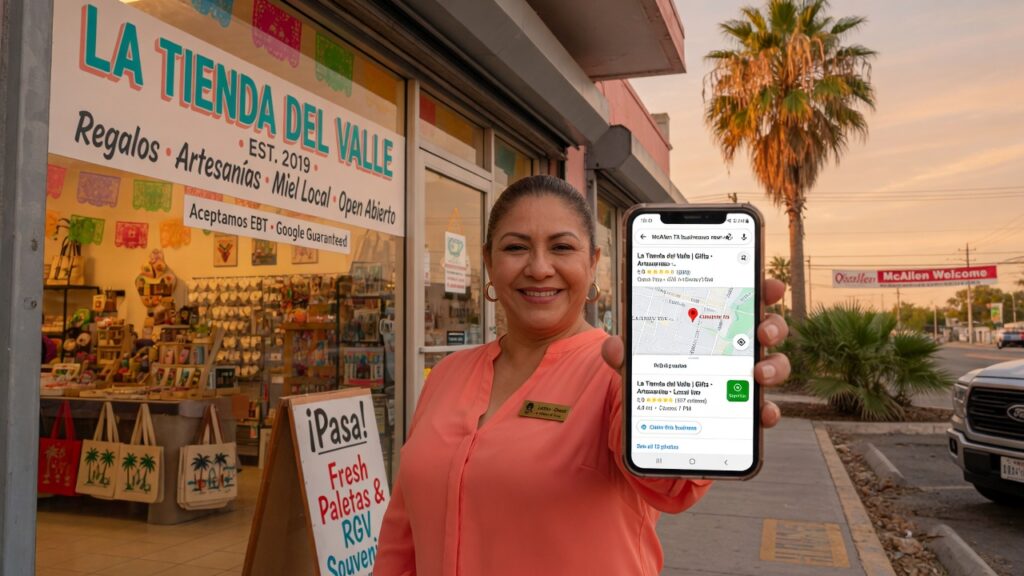
Upload new photos consistently — at minimum monthly. Profiles that go 30+ days without a new photo or post begin to lose visibility in local rankings.
Step 5: Post Weekly — Treat It Like a Mini Social Feed
Google Posts are one of the most underused features in local SEO McAllen businesses have access to. Posts act as a freshness signal and add context about what is happening right now. When Google sees ongoing activity, it gains confidence that the business is still operating and engaged with customers. Big Red SEO
Post weekly with updates like: a new menu item, a current promotion, a seasonal service offering, an upcoming event, or a quick tip relevant to your industry. Keep posts under 300 words, include a photo, and add a call-to-action button (“Call Now,” “Learn More,” “Book Online”).
For McAllen businesses tied to seasonal rhythms — back-to-school, tax season, quinceañera season, holiday shopping — plan your posting calendar around those local peaks.
Step 6: Build a Review Generation System
Reviews are your most powerful Google Business Profile optimization lever — and the one most businesses treat as an afterthought.
Review recency matters as much as volume. According to Google, businesses with higher ratings and consistent reviews often appear more prominently in search results. In fact, 73% of consumers only trust reviews written in the last month. Directoryone
Build a simple system: after every completed job or sale, send a follow-up text or email with a direct link to your Google review page. Train your staff to ask satisfied customers. Respond to every single review — positive and negative — within 24 hours. Your response to a negative review is often more persuasive to a prospective customer than the complaint itself.
For McAllen businesses, ask customers to mention the specific service and location in their review. A review that says “best tamale shop in south McAllen” is a local SEO signal that a generic five-star review is not.
Step 7: Complete the Services and Products Sections
Google now cross-references your website’s service descriptions with your GBP Services tab to verify your expertise. Agencyjet Every service you offer should be listed here with a specific description — not a one-word label.
Instead of listing “Haircut,” write: “Women’s precision haircut with blowout — McAllen salon serving the Rio Grande Valley.” That level of specificity helps Google match your profile to more granular search queries, bringing in higher-intent customers.
Step 8: Enable Messaging and Answer Every Question
Many customers prefer texting businesses over making phone calls. Google now monitors response times, which can affect rankings and engagement rates. LocalMighty
Enable GBP messaging and commit to responding within a few hours. For McAllen businesses with bilingual customer bases, respond in the language your customer used. It builds trust and signals cultural relevance.
The Q&A section also deserves attention. Seed it with the questions your customers actually ask — parking, hours, pricing, payment methods, wait times — and answer them thoroughly. These answers appear in your profile before a customer even visits your website.
Step 9: Keep Hours Accurate — Especially Holidays
Inaccurate hours rank among the top causes of negative reviews for local businesses. Google uses hours data to decide when your profile appears in real-time search results, so outdated information means lost visibility during your actual operating hours. The Brand Hopper
Set a recurring calendar reminder before every major holiday — Thanksgiving, Christmas, Easter, Día de los Muertos, and local RGV events — to update your special hours in advance. A customer who drives to your McAllen location on Christmas Eve and finds a locked door will leave a one-star review and never come back.
Step 10: Link Your Profile to a Well-Optimized Website
Your Google Business Profile and your website are a system — they reinforce each other. A strong review acquisition strategy, combined with a fully optimized GBP and consistent NAP citations, consistently produces local businesses ranking in the Google Maps 3-pack — often within 30–90 days of launching a focused local SEO campaign. Search Scale AI
Make sure your website has a dedicated page for each major service, that each page includes your McAllen location and service area, and that your site loads fast on mobile. Every gap in your website is a gap in your local search visibility.
Get Expert Help With Local SEO in McAllen
Google Business Profile optimization is one of those rare marketing activities where a few focused hours of work can produce compounding results for months. But doing it right — categories, descriptions, photos, reviews, posts, citations — takes consistency and expertise.
At Kennedy Media Group, we’ve been helping Rio Grande Valley businesses grow their local digital presence since 1997. If your Google Business Profile isn’t bringing in the walk-ins it should be, let’s fix that together.
7 Reasons Professional Business Photography Is Now Non-Negotiable in the RGV
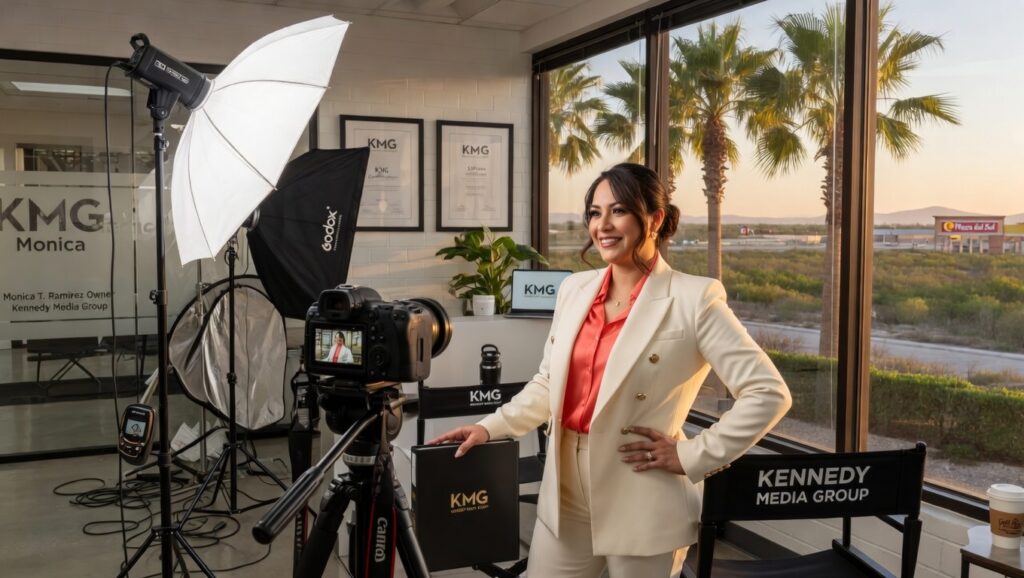
In today’s digital-first marketplace, professional business photography RGV has moved from a luxury to a competitive necessity. Whether you operate a restaurant in McAllen, a medical practice in Edinburg, a retail store in Mission, or any other local business, high-quality, authentic images directly impact how customers perceive and interact with your brand.
Here are the 7 reasons why professional business photography is now non-negotiable for success in the Rio Grande Valley.
1. First Impressions Happen in Seconds – Make Them Professional
Visitors form an opinion of your business within milliseconds of landing on your website or social media. Blurry smartphone snapshots or generic stock images scream “unprofessional.” Custom professional business photography RGV showcases your real team, products, storefront, and personality, instantly building credibility.
2. Authentic Images Build Trust in a Stock-Photo and AI World
Customers in the RGV value real, local businesses. With the rise of AI-generated and overused stock photos, genuine professional photography stands out and creates emotional connection. Seeing actual photos of your staff and spaces reassures potential clients that you are legitimate and invested in quality.
3. Dramatic Increase in Social Media Engagement
High-quality images drive significantly more likes, comments, shares, and saves. Studies consistently show visual content receives up to 94% more views and is 40% more likely to be shared. For RGV businesses that rely on Instagram, Facebook, and local platforms, professional business photography RGV translates into greater reach and more direct inquiries.
4. Stronger Local SEO & Google Business Profile Results
Google prioritizes visual content. Regularly adding professional photos to your Google Business Profile and website improves local search visibility for terms like “business near me” or “McAllen [your industry].” Professional images also boost click-through rates and time-on-site signals that help rankings.
5. Consistent Branding Across Every Platform
One set of professional images can be used on your website, social media, Google listings, email campaigns, print ads, and signage. This visual consistency strengthens brand recognition and makes your RGV business look established and reliable compared to competitors using mismatched or low-quality visuals.
6. Competitive Edge in a Booming Local Market
The Rio Grande Valley economy continues to grow rapidly. New businesses open every month. Professional business photography helps you stand out in a crowded marketplace—whether you’re a startup or an established company refreshing your look—by communicating quality and attention to detail that customers notice immediately.
7. Proven Return on Investment That Lasts for Years
Unlike many marketing expenses, professional business photography RGV delivers long-term value. The same images can be reused across multiple campaigns and platforms for years. Research shows professional product and lifestyle photos can increase conversion rates by up to 33% on websites and e-commerce pages, delivering measurable results to your bottom line.
Ready to make professional business photography work for your RGV business?
Kennedy Media Group, based right here in the Rio Grande Valley, delivers broadcast-quality business photography—including headshots, team photos, product shots, events, and FAA-certified drone imagery.
Contact us today to schedule your professional photoshoot and start seeing the difference quality images can make for your brand, website traffic, and sales.
7 Powerful Reasons McAllen SEO Is Transforming Local Business Growth

McAllen SEO
In the dynamic digital landscape of McAllen, TX, SEO has evolved from a buzzword to a business imperative. With over 30 years of experience, Kennedy Media Group has witnessed — and led — the transformation. From the early HTML days to AI-powered content optimization, SEO in McAllen has grown more competitive and more local. Today, businesses that don’t prioritize SEO risk fading into obscurity while their competitors thrive online.
At its core, McAllen SEO is about visibility. When someone types “best tacos in McAllen” or “emergency plumber near me,” your business must appear at the top. Why? Because clicks drive traffic, and traffic drives revenue. With thousands of websites built over three decades, Kennedy Media Group has mastered the art and science of optimizing for these hyper-local moments.
Why McAllen SEO Is Critical for Local Business Growth
Local SEO isn’t optional anymore—it’s the backbone of modern customer acquisition in McAllen. This border city boasts a unique blend of demographics, culture, and economic development. When potential customers search for services or products in McAllen, the first three results on Google usually get over 75% of the clicks. If your business isn’t there, it’s like having a store on a deserted street.
What makes McAllen SEO stand out is the hyper-local intent. Unlike national searches, people looking for local services have high purchasing intent. Whether it’s a family-owned restaurant or a local real estate agency, appearing on Google Maps, review sites, and localized content hubs ensures you capture these high-converting leads.
The Evolution of SEO in McAllen, TX
Back in the late ’90s, websites were digital brochures. SEO was rudimentary—just keywords and backlinks. Kennedy Media Group was already ahead of its time, experimenting with meta tags and directory submissions. Fast-forward to 2026, and SEO in McAllen has transformed into a sophisticated, data-driven discipline.
With the rise of mobile searches, voice queries, and AI-generated content, SEO now integrates with UX, design, and even customer service. The evolution is clear: McAllen businesses now compete on quality content, site performance, and local relevance. Staying updated with algorithm changes and industry trends is no longer optional—it’s survival.
How Kennedy Media Group Transformed McAllen SEO
For three decades, Kennedy Media Group has been at the forefront of digital innovation in the Rio Grande Valley. Having built thousands of websites for businesses across diverse industries, our approach to SEO isn’t cookie-cutter. We start with business goals, not just keywords.
From helping mom-and-pop stores dominate Google Maps to scaling enterprise-level SEO campaigns, our team has achieved remarkable results. Case in point: a local HVAC company doubled its traffic and tripled leads within six months through a hyper-local SEO campaign focused on geo-targeted content, Google Business optimization, and technical fixes.
On-Page SEO Best Practices for McAllen Businesses
On-page SEO is the foundation of any successful campaign. For McAllen-based businesses, that means using geo-modifiers like “McAllen TX” in title tags, headers, and meta descriptions. But stuffing your site with keywords? That’s old-school and dangerous.
Focus instead on:
- Writing unique, compelling meta descriptions
- Optimizing image alt texts with local references
- Structuring URLs for clarity (e.g., /mcallen-seo-services)
- Using schema markup for reviews, products, and local business info
Add in a killer CTA and ensure your content answers specific local queries — you’re golden.
Off-Page SEO Strategies That Work in McAllen
Backlinks still rule, but quality matters more than ever. For McAllen SEO success, build links through:
- Local directories (McAllen Chamber of Commerce, RGV listings)
- Guest posts on regional news sites and blogs
- Partnerships with complementary businesses
- Event coverage (fairs, local sponsorships, expos)
Trust is currency online. Google uses links as votes of confidence, so the more credible your backlinks, the higher your rank.
Local SEO Tactics for Dominating the McAllen Market
Want to rule McAllen’s search results? Then you need to:
- Claim and optimize your Google Business Profile
- Encourage customer reviews on Google, Yelp, and Facebook
- Use consistent NAP (Name, Address, Phone) info across the web
- Add location-specific landing pages for different neighborhoods
Local pack visibility can drastically boost calls and foot traffic. At Kennedy Media Group, we’ve helped businesses dominate the map by fine-tuning these elements — often with results in just 30 days.
Technical SEO for Fast, Secure, and Mobile-Friendly Sites
Speed, security, and responsiveness — the technical trio that underpins your site’s performance. In McAllen, where mobile usage far outpaces desktop, Google’s mobile-first indexing means your site must load quickly on smartphones, be secure via HTTPS, and render flawlessly across devices.
Kennedy Media Group has long prioritized these elements, deploying tools like Google PageSpeed Insights, Cloudflare CDN, and responsive frameworks to optimize client sites. If your bounce rate is high or your mobile site is clunky, that’s not just bad UX — it’s bad SEO.
A local florist in McAllen saw a 47% increase in page views simply by improving their page speed by 2 seconds. That’s how powerful technical SEO can be.
How Website Design Impacts SEO in McAllen
Web design isn’t just about pretty pixels; it’s also about user flow, site architecture, and conversion optimization. SEO-focused web design ensures that your pages are crawlable by search engines and intuitive for users.
Navigation should be simple. CTAs must be clear. Layouts should encourage exploration. Kennedy Media Group builds custom sites with SEO in mind from the wireframe stage. For example, logical URL structures, breadcrumb navigation, and siloed content sections help Google understand your site better — and reward it with higher rankings.
Voice Search and McAllen SEO Optimization
“Hey Siri, find a good mechanic in McAllen.”
Voice searches have exploded, especially for local businesses. These queries tend to be longer, more conversational, and often urgent. Optimizing your site for voice search in McAllen means using long-tail keywords, FAQ schemas, and natural language in your content.
We recommend targeting questions your audience might actually ask — and formatting them clearly. That way, you increase your chances of being featured in voice snippets or “position zero” on Google.
Content Marketing Strategies for McAllen SEO
Content is still king — but context is the new crown. In McAllen, content must resonate locally while still offering real value. This means publishing:
- Blog posts about McAllen events
- Local case studies and client success stories
- Area guides, how-tos, and educational resources
Kennedy Media Group leverages content calendars tailored to local events (like the McAllen Holiday Parade or PalmFest), ensuring relevancy and engagement. Evergreen content infused with timely updates keeps your SEO fresh and effective.
The Role of Social Media in McAllen SEO
While social signals may not be a direct ranking factor, the indirect impact is undeniable. Shares, likes, comments, and brand mentions amplify your visibility, drive traffic, and earn backlinks.
For McAllen businesses, platforms like Facebook, Instagram, and Nextdoor serve as hyper-local engagement hubs. An active social presence helps boost content reach, build brand trust, and ultimately, strengthen your site’s authority.
Understanding SEO Analytics and KPIs in McAllen
What gets measured gets managed. SEO without analytics is like navigating without a map. Kennedy Media Group uses tools like Google Analytics 4, Search Console, and CallRail to monitor performance.
Key KPIs include:
- Organic traffic
- Click-through rates (CTR)
- Keyword rankings
- Local pack visibility
- Conversion rates
We create custom dashboards for clients to track performance in real-time, ensuring that every SEO dollar is accounted for — and optimized.
Common McAllen SEO Mistakes to Avoid
Even seasoned businesses can fall into SEO traps. In McAllen, we’ve seen companies tank their rankings by:
- Keyword stuffing their pages
- Duplicating content across service areas
- Buying low-quality backlinks
- Ignoring mobile users
- Failing to update outdated pages
Avoid these pitfalls by auditing your site regularly. Kennedy Media Group provides complimentary local SEO audits to diagnose and correct these issues before they become catastrophic.
Top SEO Tools Used by Agencies in McAllen
To execute high-performing SEO campaigns, you need the right tools. Our go-to stack includes:
| Tool | Purpose |
|---|---|
| Ahrefs | Backlink analysis & keyword research |
| SEMrush | Competitive research & site audits |
| Google Search Console | Crawl stats & index monitoring |
| BrightLocal | Local SEO & citations tracking |
| Screaming Frog | Technical SEO & site architecture |
| Yoast SEO | On-page content optimization |
These tools provide actionable insights, but remember — tools are only as effective as the strategist behind them.
Case Study: McAllen Business Success via SEO
One of our most compelling local success stories involved a McAllen-based medical spa. They struggled with online visibility despite having a beautiful location and quality service. We started with a local SEO audit and found key issues: duplicate listings, poor page speed, and lack of location-based content.
After implementing a tailored McAllen SEO strategy — including schema markup, content revamp, and GMB optimization — they saw:
- 132% increase in organic traffic
- 52% jump in booked appointments
- Top 3 rankings for 15+ local keywords
Within 6 months, their digital visibility matched the caliber of their in-person service.
How to Choose the Right McAllen SEO Agency
Choosing a local SEO partner is a big decision. Ask the right questions:
- Do they specialize in local SEO?
- Can they show case studies with real results?
- Do they offer transparent reporting?
- Are their tactics white-hat and Google-compliant?
Kennedy Media Group proudly ticks all these boxes. With over 30 years in business and thousands of websites delivered, we bring legacy and innovation together.
DIY vs. Professional SEO in McAllen
Sure, you can watch YouTube tutorials and read SEO blogs. But when it comes to beating your competition in McAllen’s saturated market, experience matters. DIY SEO often lacks:
- Strategic direction
- Technical depth
- Data interpretation skills
Professional SEO, on the other hand, accelerates growth with fewer risks and more sustainable results. Consider it an investment — not an expense.
Kennedy Media Group’s Unique SEO Approach
What sets Kennedy Media Group apart is our holistic, customized, and client-first approach. We don’t offer cookie-cutter packages. Instead, we dive deep into your business model, competition, and audience to build an SEO strategy that aligns with your goals.
Whether it’s launching a brand-new business or rescuing an underperforming site, we offer services that scale — and succeed.
Integrating SEO with Paid Advertising in McAllen
SEO and PPC aren’t rivals — they’re partners. A blended strategy helps dominate both paid and organic results, increasing your visibility and click-share.
Our clients in McAllen benefit from integrated dashboards that monitor both Google Ads and organic performance. The result? Better ROI, faster testing, and more accurate targeting.
SEO for E-Commerce Businesses in McAllen
Selling online in McAllen? Then your SEO must address:
- Product optimization
- Schema markup for inventory and reviews
- Mobile shopping experience
- Conversion rate optimization
Kennedy Media Group helps e-commerce brands rank higher and sell more through SEO-driven product pages, intuitive navigation, and cart-flow optimization.
Industry-Specific SEO Tactics in McAllen
Each industry has its own SEO nuances. Here’s how we tackle a few:
- Medical Practices: HIPAA-compliant content, review management, patient FAQs
- Real Estate: IDX integration, neighborhood landing pages
- Restaurants: Menu schema, local citations, reservation integrations
- Law Firms: Case types, legal content compliance, GMB optimization
We tailor McAllen SEO strategies based on both vertical and geographic dynamics.
What Sets McAllen SEO Apart From Other Cities
McAllen is unique — a blend of border culture, bilingual audiences, and rapid economic growth. SEO here isn’t just about ranking; it’s about cultural resonance, language considerations, and mobile-first user behavior.
National strategies don’t always work here. Local insight is key, and that’s where Kennedy Media Group shines.
The Future of SEO in McAllen, TX
The next chapter of SEO in McAllen will be shaped by:
- AI-generated content and personalization
- Voice search and smart assistants
- Search experiences without clicks (zero-click searches)
- Video-first content optimization
Staying ahead of the curve is essential. As trends evolve, Kennedy Media Group continues to innovate, test, and deploy future-proof SEO solutions.
Getting Started with McAllen SEO Today
If you’re ready to increase your visibility, grow your revenue, and outshine your competition in McAllen — start with an audit. Kennedy Media Group offers free consultations to assess your current standing and opportunities.
Whether you’re a startup, a family-run business, or an enterprise player, we have the tools, team, and tenacity to take your SEO to the next level.
FAQs
What is McAllen SEO and why is it important?
McAllen SEO refers to local search engine optimization strategies tailored for businesses in McAllen, TX. It’s crucial for boosting online visibility, increasing leads, and reaching local customers effectively.
How long does it take to see SEO results in McAllen?
Most businesses begin seeing results in 3–6 months, depending on competition and current site health. Local businesses often see quicker improvements in Google Maps and local pack rankings.
Is Kennedy Media Group the best SEO agency in McAllen?
With 30 years of experience and thousands of websites built, Kennedy Media Group is a top contender for SEO services in McAllen. Our client success stories and personalized strategies speak for themselves.
Can I do SEO myself for my McAllen business?
Yes, but it’s time-consuming and complex. DIY efforts may lack strategy and risk non-compliance with Google guidelines. Professional help is recommended for long-term growth.
What industries benefit most from McAllen SEO?
Every local industry — from healthcare and legal to restaurants and retail — can benefit from local SEO. Any business with a physical location or service area will see increased traffic and visibility.
What sets McAllen SEO apart from general SEO?
McAllen SEO focuses on hyper-local intent, mobile usage, bilingual considerations, and regional competition. It requires a unique approach that understands the city’s cultural and consumer nuances.
Conclusion
In the heart of South Texas, McAllen SEO is no longer just an option — it’s a strategic advantage. With increasing online competition and evolving algorithms, businesses that embrace SEO stand to thrive. Kennedy Media Group, with its 30-year legacy, offers a local, hands-on, and results-driven approach that has empowered thousands of clients.
Whether you’re starting fresh or scaling up, let Kennedy Media Group be your compass in the SEO journey. McAllen is growing — and with the right digital strategy, so can your business.
7 Reasons Professional Website Design Transforms Your Business Online
7 Reasons Professional Website Design Transforms Your Business Online
Your business website is working — or failing — around the clock, long after your doors close. In the time it takes a visitor to blink, they’ve already formed an opinion about your brand. Research consistently shows that first impressions form in as little as 50 milliseconds based on visual design alone. That means professional website design isn’t a luxury — it’s one of the most important investments your business can make.
Here are 7 reasons why getting your website right changes everything.
1. First Impressions Are Made in Milliseconds
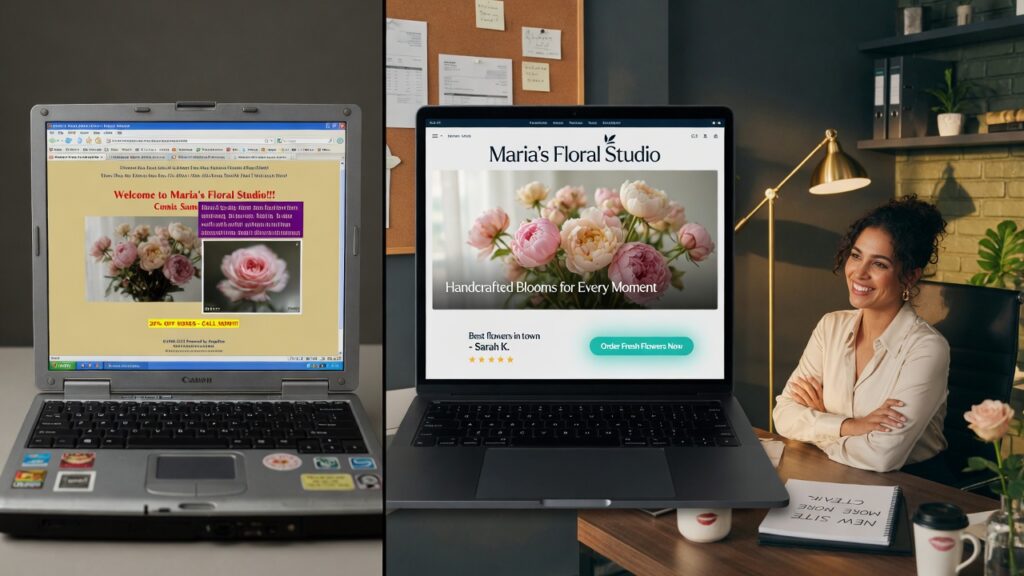
Before a visitor reads a single word on your site, they’ve already decided whether they trust you. A polished, intentional design communicates credibility instantly. A cluttered or outdated layout does the opposite — it signals that your business may be equally disorganized. Professional website design gives your brand the authority it deserves from the very first glance.
2. Professional Website Design Builds and Reinforces Your Brand
Your business website should be a direct visual extension of your brand — its values, personality, and promise. Consistent use of color, typography, photography, and messaging creates a memorable identity that sticks with visitors long after they’ve left your page. Without this cohesion, even a great product or service gets lost.
3. Good Design Dramatically Improves User Experience
A well-structured business website makes it effortless for visitors to find what they’re looking for. Intuitive navigation, clear calls-to-action, logical page hierarchy, and a mobile-responsive layout all reduce friction — and reduced friction means more conversions. When people can’t find what they need in seconds, they leave. It’s that simple.
4. It Directly Impacts Your Search Engine Rankings
Professional website design and SEO are not separate disciplines — they’re deeply connected. Google evaluates page speed, mobile-friendliness, Core Web Vitals, content structure, and user engagement signals when deciding where to rank your site. A poorly designed website hurts your SEO regardless of how well-written your content is. According to Google’s Web Vitals documentation, sites that deliver fast, stable, and responsive experiences rank higher and retain more visitors.
5. It Keeps Visitors on Your Site Longer
Dwell time — how long a visitor stays on your site — is both a reflection of good design and a signal search engines use to evaluate quality. Engaging visuals, readable typography, well-paced content, and purposeful layout all encourage visitors to explore deeper. The longer they stay, the more likely they are to reach out, buy, or book.
6. It Converts Browsers Into Buyers
A beautiful business website that doesn’t convert is just expensive artwork. Professional website design strategically guides visitors toward action — whether that’s filling out a contact form, making a purchase, or picking up the phone. Strategic placement of trust signals (testimonials, credentials, portfolio work), combined with clear CTAs, is what separates a site that generates leads from one that just exists.
7. It Future-Proofs Your Online Presence
The digital landscape shifts fast. A professionally designed business website built on a solid platform like WordPress is scalable, maintainable, and adaptable as your business grows. It can integrate new tools, accommodate new content, and evolve without requiring a full rebuild every two years. That’s not just good design — that’s smart infrastructure.
Your website is your hardest-working employee. It’s available 24 hours a day, never calls in sick, and represents your brand to every potential customer who searches for you online. If it’s not making the right impression, it’s costing you business every single day.
At Kennedy Media Group, we’ve been building professional websites for Rio Grande Valley businesses since 1997. If your site is overdue for a redesign — or you’re starting from scratch — let’s talk.
How Adaptive Business Strategy Drives Growth in a Changing Market

In a fast-moving marketplace, success doesn’t come from sticking rigidly to a plan. It comes from learning to adapt—and fast.
Having a solid business plan is important. But real-world business is unpredictable. Customer preferences shift. Competitors launch new offerings. Economic forces change overnight. This is why the most successful companies today are blending a strong tactical foundation with an adaptive business strategy to stay ahead.
Why Do Businesses Struggle to Keep Up?
Even great businesses hit roadblocks. The most common disruptions include:
- Shifting Customer Expectations – Audiences evolve. What worked last year might not work now.
- Competitive Pressure – New players or innovations can quickly change the playing field.
- Market Volatility – External factors like economic downturns, supply chain issues, or global events can throw off forecasts.
Two Approaches: Tactical vs Adaptive Performance
Tactical performance is about executing a clear, detailed plan. It’s structured, predictable, and useful for meeting predefined goals. But on its own, it can become rigid.
Adaptive performance, by contrast, is your organization’s ability to deviate from the plan when new opportunities or risks emerge. It involves improvisation, experimentation, and creative problem-solving.
The best-performing businesses know how to combine both. They stay grounded in strategic objectives while leaving room for agility and innovation.
Rethinking Incentives: Why Traditional Rewards Fall Short
In many companies, performance is measured by static targets—hit the goal, get the bonus. But this can unintentionally discourage innovation. Employees may fear failure or avoid testing bold ideas.
Instead, businesses should reward curiosity, experimentation, and learning. Encourage your team to explore new methods. Create space for calculated risk-taking. Build a culture that values iteration over perfection.
How Adaptive Business Strategy Pays Off
- Increased Customer Satisfaction – You can pivot quickly to meet changing customer needs.
- Greater Team Engagement – Employees feel trusted and motivated when encouraged to solve problems creatively.
- Higher Profitability – Businesses that adapt faster can seize new opportunities before competitors do.
Bottom line? A rigid strategy may keep things stable, but an adaptive strategy ensures your business survives—and thrives—in uncertain times.
Balance structure with flexibility. Empower your team to act. And let your strategy evolve as your business grows.
7 Proven Strategies to Boost Foot Traffic to Your Retail Store
7 Proven Strategies to Boost Foot Traffic to Your Retail Store
Are you struggling to drive foot traffic to your retail store? You’re not alone — and the good news is, the fix doesn’t require a massive budget. It requires strategy. Below are seven proven tactics that retail store owners across industries have used to attract more customers, increase dwell time, and turn browsers into buyers.
1. Create an Immersive In-Store Experience That Drives Retail Store Foot Traffic
The single greatest advantage a retail store has over e-commerce is the experience. Online stores can’t offer smell, texture, sound, or the satisfaction of walking out with something in hand. Use that to your advantage.
Build an ambiance that appeals to all the senses — curated music, cohesive visual merchandising, interactive product displays, and efficient queue management. Exceptional customer service, deep product selection, and a well-organized floor plan will keep customers coming back.

2. Play Up the Instant Gratification Factor
Remind your customers of what they can’t get online: they can take it home today. No shipping wait. No tracking anxiety. No return hassle.
Signage, staff training, and social posts that emphasize immediacy — “In Stock Now,” “Take It Home Today” — subtly reinforce the advantage your retail store has over digital competitors.
3. Use Social Coupons and In-Store-Only Offers
Drive foot traffic by creating deals that can only be redeemed in person. Social coupons distributed via Instagram Stories, Facebook posts, or even QR code flyers create urgency and require a physical visit to redeem.
These promotions also generate user-generated content when customers share their finds — giving you organic reach at zero extra cost.
4. Turn Your Team Into Brand Ambassadors
Your employees are your most underutilized marketing asset. A team that genuinely loves the brand will make visiting your store feel contagious. Invest in staff culture, product knowledge training, and incentive programs that reward excellent customer interactions.
When your crew is excited, customers feel it — and they tell people.
5. Run Loss-Leader Promotions Around Memorable Events
Tie a bold promotion to a local event, holiday, or cultural moment. A well-executed loss-leader campaign — where one deeply discounted item draws a crowd — can flood your retail store with new customers who also buy full-margin products.
Pair this with a neighborhood domination strategy (mailers, geofenced digital ads, window signage) and the ripple effect on your location’s visibility will be long-lasting. According to the National Retail Federation, experiential retail tied to community events consistently outperforms standard promotions in customer retention.
6. Mine Your Customer Data for Behavioral Insights
Who are your most loyal customers? What products bring them back? What lifestyle changes drive their purchasing behavior?
Your POS system, loyalty program, and social media analytics are goldmines of insight. Use that data to optimize your product mix, adjust your store layout, and personalize promotions. Retailers who act quickly on customer data outperform those who gut-check alone. Google’s retail insights research confirms that purchase decisions increasingly begin online — meaning your in-store experience must deliver on what your digital presence promises.
7. Partner With a Digital Agency That Understands Retail Store Marketing
Increasing foot traffic to your retail store isn’t just about what happens inside four walls — it starts online. Your website, Google Business Profile, local SEO, and social media presence all drive people through your door before they ever see your storefront.
At Kennedy Media Group, we’ve helped Rio Grande Valley retail businesses build the digital presence that converts online searches into in-store visits. If you’re ready to grow, let’s talk.
9 Cardinal Rules for a Winning Content Marketing Strategy
9 Cardinal Rules for a Winning Content Marketing Strategy
You’ve invested everything into your business. To you, it’s the center of the universe. Here’s the uncomfortable truth — the rest of the world doesn’t know that yet. But with the right content marketing strategy, you can change that. Done correctly, content pulls customers toward you naturally, builds lasting trust, and positions your brand as the obvious choice in your industry.
These 9 cardinal rules are the foundation of every successful content marketing strategy — whether you’re a solo entrepreneur or a growing company here in the Rio Grande Valley.
Rule #1: Focus on Your Audience — Not Yourself
Your customers don’t care about your business. They care about their own problems. A strong content marketing strategy starts with one question: What does my audience need? Write for them. Speak to their pain points, their goals, and their questions. The moment your content stops being about you and starts being about them, everything changes.
Rule #2: Stop Copying Your Competitors — Be Memorable
Imitation is the death of brand differentiation. If your content looks like everyone else’s, it gets ignored like everyone else’s. Study your competitors enough to understand the landscape, then deliberately go in a different direction. Memorable brands don’t follow the conversation — they start it.
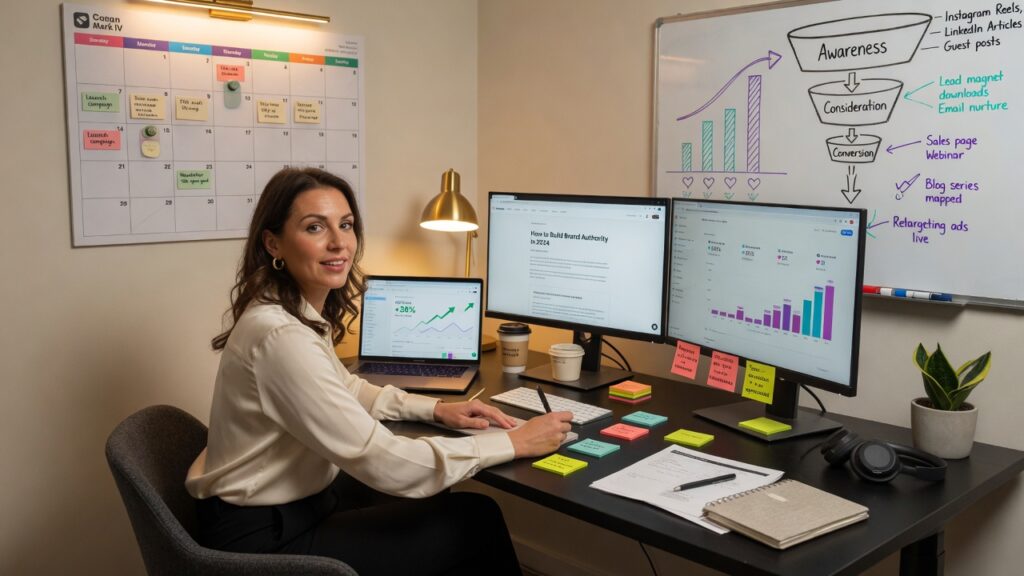
Rule #3: Have a Plan, Set Goals, and Measure Everything
A content marketing strategy without measurable goals is just publishing. Define what success looks like — more website traffic, more leads, more conversions — and track your progress consistently. According to the Content Marketing Institute, marketers with a documented strategy are significantly more likely to report success than those without one.
Rule #4: Do Something That Hasn’t Been Done Before
If your content feels safe, it probably won’t perform. The best content strategy for business pushes into uncomfortable territory — a bold opinion, an unconventional format, a story nobody else is willing to tell. You’ll know you’re on the right track when the idea makes you feel a little queasy but excited at the same time.
Rule #5: Make Your Content So Valuable They Can’t Ignore It
Your audience is drowning in content. The only pieces that break through are the ones they have to pay attention to — because the information is so useful, so relevant, or so well-produced that skipping it would be a loss. Set that bar for every piece you publish.
Rule #6: Forget Instant Gratification — This Is a Marathon
Content marketing doesn’t pay off in a week. It compounds over months and years. Businesses that abandon their content marketing strategy after 60 days never see the results that the businesses who stayed consistent for 12 months enjoy. Commit to the long game and protect your consistency like it’s a business asset — because it is.
Rule #7: Lift Your Audience to Your Level
If you want to be seen as the leader in your industry, your content has to educate. Bring your audience along on the journey. Teach them what you know. The more you elevate their understanding, the more they trust you as the expert — and the more naturally they turn to you when they’re ready to buy.
Rule #8: Own the Conversation in Your Niche
Choose content topics that let you lead the dialogue in your space. This is how brands develop a distinctive voice and a recognizable story. When you consistently publish on a focused set of topics, search engines reward you with authority — and your audience rewards you with loyalty.
Rule #9: Don’t Blow Your First Impression
You have two seconds. Maybe less. Your headline, your opening line, and your visual need to earn attention immediately — or your audience is gone. Every piece of content you publish is a first impression for someone who has never heard of you. Make it count.
A well-executed content marketing strategy is one of the highest-ROI investments a business can make. If you’re ready to build a content plan that actually works for your brand, Kennedy Media Group has been helping Rio Grande Valley businesses grow their digital presence since 1997. Let’s talk.
Facebook Marketing for Small Business: The Organic Reach Truth in 2026
Facebook Marketing for Small Business: The Organic Reach Truth in 2026
I’ve been building and managing websites and marketing campaigns for small and mid-size businesses across the Rio Grande Valley for nearly 30 years. One thing has remained constant in almost every client kickoff meeting: someone asks about their Facebook Page.
It’s the expected item on every digital marketing checklist. Set it up, get likes, post content, watch customers roll in. It sounds brilliant. And for a long time, it was the conventional wisdom.
But the reality of Facebook marketing for small business is more complicated — and more expensive — than most business owners realize. Let me break it down.
The Promise: Organic Reach
The fundamental pitch behind a Facebook Business Page is called organic reach — the idea that when you post something, the people who’ve “liked” your page will see it in their feed for free. You build an audience, you post to that audience, and your marketing message gets out.
This is what almost every small business owner believes when they invest time and money into growing their Facebook following.
It sounds wonderful. And it used to work.
The Reality: You’re Paying Twice
Here’s where Facebook marketing for small business breaks down in practice.
You invest money — either through boosted posts or Facebook ads — to get people to like your page. This feels like building a subscriber list, a database of people interested in your brand. It feels justified.
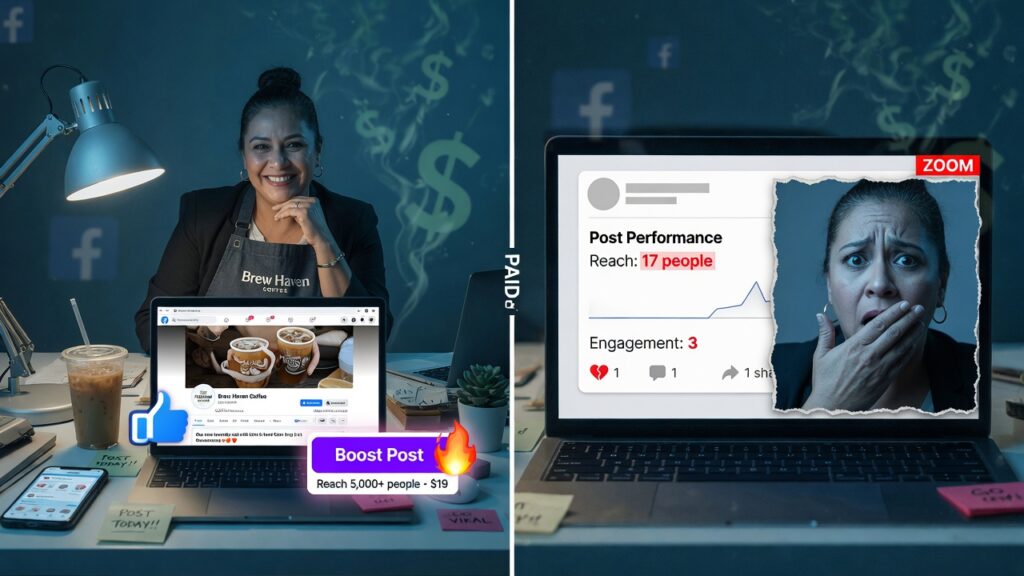
Then you create great content. Your designer works up a polished graphic. You write a compelling post. You hit publish. And then… almost nobody sees it.
Facebook’s organic reach across 2024 measured just 1.37%, with a median engagement rate of 0.2%. Keefomatic That means if you have 500 followers, roughly 7 of them will see your post. Organically.
To put that in plain terms: it’s like building an email list of 500 people and your email system randomly sending to only 7 of them. You’d fire your email provider. But with Facebook, people just keep boosting posts.
So now you have two costs: paying to build the audience, and then paying again to reach the audience you already paid to build. Facebook is an advertising company first and foremost, and it has a vested interest in making organic reach more difficult in order to compel brands to pay to promote their posts. Marketing Scoop
How Did We Get Here?
This wasn’t always the case. Back in 2012, Facebook’s average organic reach was a healthy 16%. By 2025, it hovered between 1–2%. Hootsuite Blog The decline has been steady and intentional.
In January 2018, Facebook made a monumental change to its News Feed algorithm, announcing it would prioritize “meaningful social interactions” and show more posts from friends and family over brands and publishers. Organic reach for Pages dropped 35% on average in the wake of this single change. Marketing Scoop
The algorithm now decides what gets seen based on engagement signals — time spent, comments, shares, reactions. If your first few exposures don’t generate interaction, the post stops spreading. A skilled marketer who understands timing, content format, and audience psychology can nudge those numbers upward. But most small businesses aren’t running optimized social strategies — they’re just posting announcements into the void.
So Is Facebook Useless for Small Business?
Not entirely — but the role has fundamentally changed, and understanding that shift is critical to not wasting your budget.
Where Facebook still has real value for small businesses:
As a credibility signal. Your Facebook Page is often the first place a potential customer checks after hearing your name. An active, well-maintained page with reviews, photos, and recent posts builds trust. An abandoned page does the opposite. Think of it as a digital storefront window — people look before they walk in.
As the gateway to Meta’s ad platform. You cannot run ads on Facebook or Instagram without a Facebook Business Page. 12amagency Meta’s paid advertising ecosystem — with its hyper-specific demographic, behavioral, and geographic targeting — is genuinely one of the most powerful tools available to small businesses. But you need the Page to access it.
For local community and events. Facebook Groups and local event promotion still perform well for community-based businesses — restaurants, venues, retail, and entertainment. These formats drive actual conversation rather than one-way broadcasting.
What Facebook is NOT in 2026: a free broadcast channel. The days of posting and expecting your followers to organically see your content are effectively over for business pages.
Where to Put Your Energy Instead
If you’re a small business operating on a limited marketing budget, here’s the honest allocation:
Your website is the only digital asset you actually own. Your Facebook page, your followers, your content — Meta can change the rules on any of it overnight (and they have, repeatedly). Your website belongs to you.
Your email list is the closest thing to true organic reach that exists. An email to your list goes to your list — not to a random 1.37% of it. Build it aggressively.
Paid Facebook ads — when run strategically with proper targeting, creative, and tracking — can deliver strong ROI. But treat Facebook as a paid channel from the start, not a free one that occasionally requires boosts.
The Bottom Line
Facebook marketing for small business isn’t dead — but the promise of free organic reach has been. It died years ago, and the data confirms it gets worse every year.
The businesses succeeding on Facebook in 2026 are the ones who accepted this reality early: they use the Page for credibility and as the foundation for paid advertising, they don’t measure success in likes, and they don’t confuse a follower count with a customer database.
Run the numbers on your Facebook efforts. Compare the time and budget you’ve put in against the actual leads or sales you can trace back to the platform. Then reallocate accordingly.
At Kennedy Media Group, we help Rio Grande Valley businesses build digital marketing strategies built around assets they actually own — and we’re honest about where every dollar goes. If your current approach isn’t converting, let’s talk.
How to Run a Social Media Giveaway: 5 Rules + Texas Legal Guide
How to Run a Social Media Giveaway: 5 Rules + What Texas Law Requires
Running a social media giveaway is one of the fastest ways to grow your audience, generate buzz, and reward your customers. Done right, an online contest can produce thousands of impressions, hundreds of new followers, and real leads — all without a paid ad budget.
But done wrong, it can expose your business to legal risk. Texas has specific laws governing contests, giveaways, and sweepstakes — and most business owners have no idea they exist.
This guide covers both: the 5 strategic rules for running a successful social media giveaway, and what Texas law actually requires before you launch.
Rule #1: Define Your Goal Before You Design the Contest
Every successful social media giveaway starts with a single, measurable goal. Are you trying to grow your Facebook following? Generate email leads? Drive traffic to your website? Reward existing customers? The mechanics of your contest — how people enter, what they win, how long it runs — should all serve that one goal.
A giveaway without a goal is just noise. A giveaway with a clear goal is a campaign.
Rule #2: Choose the Right Prize for Your Audience
The prize is what drives participation. Generic prizes like cash or gift cards attract everyone — including people who will never become customers. The best online contest prizes are things your ideal customer actually wants: your product, your service, an experience tied to your brand, or something highly relevant to your niche.
The more targeted the prize, the more targeted your entries — and the higher your post-contest conversion rate.
Rule #3: Make Entry Simple and Platform-Native
Complicated entry processes kill participation. The best-performing social media giveaway formats on Facebook and Instagram are frictionless: like the post, tag a friend, follow the page, share to your story. Each of these actions also amplifies organic reach, turning your contestants into your promoters.
Keep the entry steps to two or three maximum. Every extra step you add cuts your entry rate.
Rule #4: Publish Clear Official Rules — Every Single Time
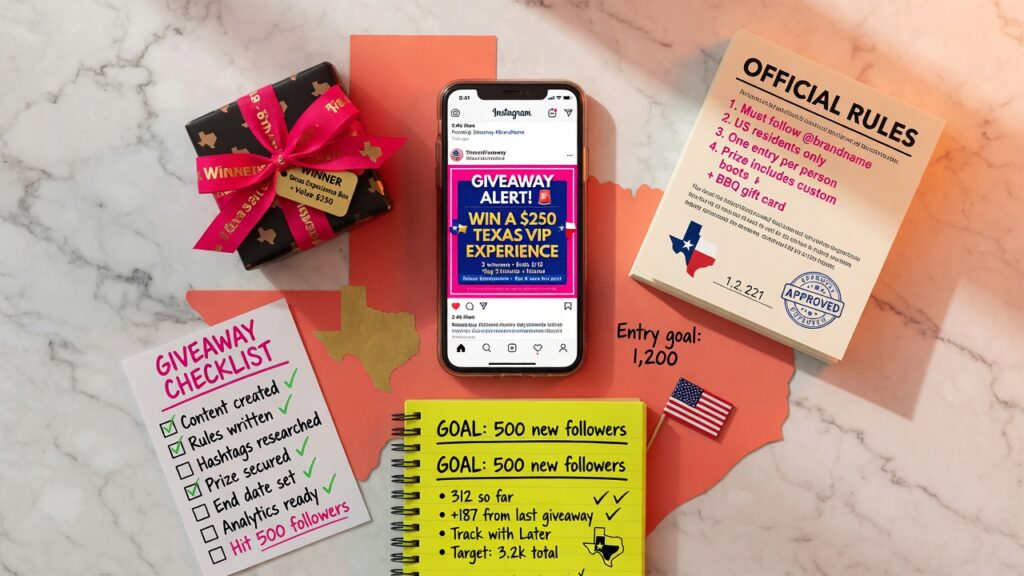
This isn’t optional, and it’s not just about optics — it’s a legal requirement. Your giveaway rules must clearly state the start and end dates, how winners will be selected and notified, prize details and approximate retail value, eligibility requirements (age, location), and a “No Purchase Necessary” declaration for sweepstakes-style promotions.
Post the rules directly in the caption or link to a dedicated rules page. Platforms like Facebook and Instagram also require you to include a disclaimer that the promotion is not sponsored by, endorsed by, or affiliated with the platform.
Rule #5: Follow Through With a Public Winner Announcement
The most overlooked step in running an online contest is the winner reveal. Announcing your winner publicly — on the same platform where you ran the giveaway — builds trust, validates the contest’s legitimacy, and gives you one more piece of engaging content. It also closes the loop for everyone who entered and didn’t win, making them more likely to participate next time.
Document everything: screenshots of your winner selection, DMs, and confirmation of prize delivery.
⚖️ Texas Law: What Every Business Owner Needs to Know Before Running a Giveaway
This is the part most marketing guides skip — and it’s the part that matters most if your business operates in Texas.
Contests vs. Sweepstakes vs. Raffles — They’re Not the Same Thing
Texas law treats these three promotion types very differently:
A sweepstakes awards prizes based on chance. No purchase can be required to enter. This is the most common format for social media giveaways — “like and tag to win” — and it’s fully legal for any Texas business as long as entry is free.
A contest awards prizes based on skill or merit — photo contests, caption competitions, recipe submissions. In Texas, an entry fee or purchase can be required for a skill-based contest without needing a free alternate entry method, unlike sweepstakes.
A raffle requires participants to purchase a ticket for a chance to win. In Texas, only qualified nonprofit organizations are permitted to hold raffles — individuals and for-profit businesses are not. Raffles For Less Under the Charitable Raffle Enabling Act, qualifying nonprofits must have existed in Texas for at least three years. Raffles For Less If your business is for-profit and you’re charging for entries, you’re running an illegal lottery — not a raffle.
The Three-Part Lottery Test
To avoid running an illegal lottery, your promotion must eliminate at least one of three elements: prize, consideration (payment/purchase), and chance. Business.com A standard social media giveaway eliminates consideration by making entry free — that’s what keeps it legal.
A sweepstakes is legal as long as there is no purchase required for participation; if a purchase or significant effort is involved, a free alternate method of entry must also be present. Nationalsweepstakescompany
Texas-Specific Rules Under the Contest and Gift Giveaway Act
Texas Business & Commerce Code Chapter 621 — the Contest and Gift Giveaway Act — governs how businesses must operate contests and gift promotions in the state. Texas State Law Library Key requirements include:
Disclose the odds. For drawings, you must clearly disclose the odds of winning each prize, the exact prizes to be awarded, and the beginning and ending dates of the contest period. Justia If the total number of entries isn’t known, state that odds depend on entries received.
Don’t mislead participants. Texas law prohibits using terms like “finalist,” “winner,” or “grand prize recipient” in a false or misleading way, or representing that a person has won or will win when that isn’t true. Findlaw
You must award the prize. If a major prize is not claimed during the contest period, the offeror must conduct a drawing no later than 60 days after the contest period ends, and every promised prize must be awarded. Justia
Keep records. For contests other than drawings, businesses must maintain records — including identity of those who ran the promotion, prize winner lists, and supporting documentation — until the second anniversary of the date the last prize was awarded. Texas.Public.Law
Prize conditioning is prohibited. An offeror may not notify a person that they’ve won a prize if receipt of that prize is conditioned on purchasing a good or service unrelated to the prize. Justia
For Sweepstakes with Prizes Over $50,000
In Texas, any sweepstakes with a prize valued over $50,000 is prohibited from automatically entering consumers into the promotion when purchases are made. Rtm For most small business giveaways, this threshold won’t apply — but if you’re running a major promotion, it’s a line you need to know about.
Federal Rules Apply Too
Beyond Texas law, federal rules from the FTC govern all promotional contests nationwide. Winners receiving prizes valued over $600 must receive a 1099 tax form and report the value as miscellaneous income. Prize values must be disclosed as ARV (Approximate Retail Value). And all promotions must be honest and non-deceptive under FTC consumer protection guidelines.
A Note on Platform Rules
Facebook and Instagram both have their own promotional guidelines that run alongside the law. Both platforms require you to acknowledge that they are not sponsors and have no involvement in the promotion. Always include this disclaimer in your post or official rules.
The bottom line: A well-run social media giveaway can do tremendous things for your brand. But it needs to be built on a solid legal foundation. When in doubt, consult a Texas-licensed attorney before launching — especially if prizes are significant, entry mechanics are complex, or you’re unsure whether your promotion crosses into raffle territory.
At Kennedy Media Group, we help Rio Grande Valley businesses plan and execute social media giveaways and digital marketing campaigns that are both effective and compliant. Let’s build your next campaign together.
Disclaimer: This article is for informational purposes only and does not constitute legal advice. Laws can change. Consult a licensed Texas attorney before running any promotional contest or giveaway.
How to Build a Small Business Marketing Plan That Actually Works: 10-Step Guide
How to Build a Small Business Marketing Plan That Actually Works: 10-Step Guide
Every successful business, regardless of size or budget, runs on a small business marketing plan. Without one, you’re not marketing — you’re guessing. You’re posting without purpose, spending without direction, and measuring without benchmarks.
A good marketing strategy doesn’t have to be a 40-page document. In fact, the most effective plans are focused, flexible, and built around real data. Whether you’re launching a new venture or refreshing an existing one, this 10-step guide will walk you through every component of a plan that generates measurable results.
Step 1: Conduct a Situational Analysis (Know Where You Stand)
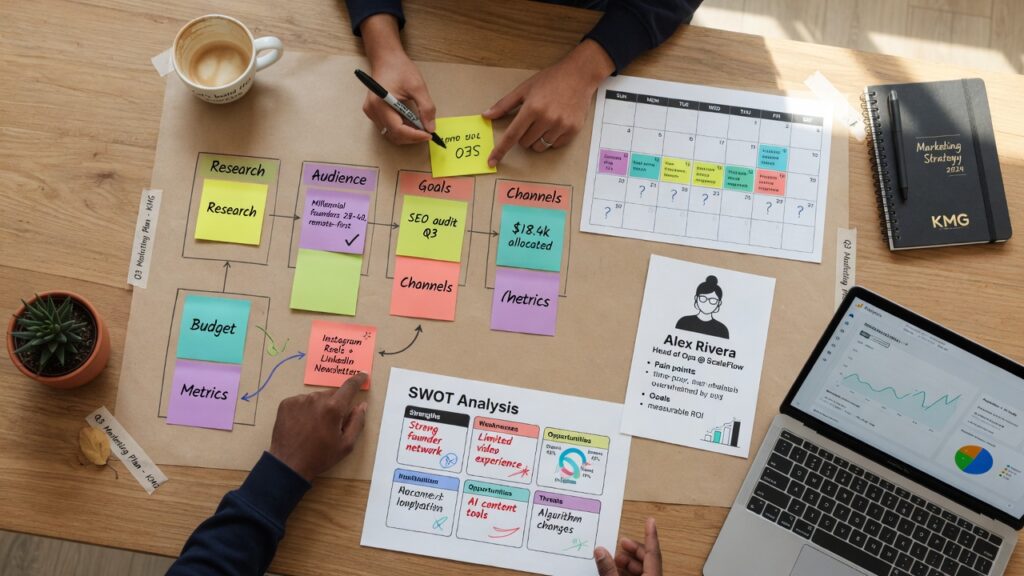
Before you plan where you’re going, you need an honest picture of where you are. The most effective framework for this is a SWOT analysis — an assessment of your business’s Strengths, Weaknesses, Opportunities, and Threats.
Your Strengths are internal advantages: your experience, your location, your loyal customers, your pricing, your team. Your Weaknesses are internal gaps: limited budget, thin online presence, staff turnover, inconsistent branding. Opportunities are external conditions working in your favor: growing local demand, a competitor closing, an underserved niche. Threats are external forces that could hurt you: new competitors, economic shifts, platform algorithm changes, supply chain issues.
Be brutally honest here. The SWOT analysis is the foundation everything else builds on.
Also gather hard data at this stage: your current sales volume and seasonal patterns, your website traffic and conversion rates, your customer acquisition costs, and your best-performing existing marketing channels.
Step 2: Define Your Target Audience (Build a Buyer Persona)
Vague targeting produces vague results. Your small business marketing plan needs to define exactly who you’re selling to — not just “adults 25–54” but a specific, researched profile of your ideal customer.
Build at least one buyer persona: a semi-fictional representation of your best customer based on real data. Include demographics (age, gender, income, location), psychographics (values, lifestyle, goals, pain points), buying behavior (how they research, where they shop, what triggers a purchase), and preferred communication channels (email, Instagram, Google search, word of mouth).
The more specifically you can describe your ideal customer, the more precisely you can reach them — and the less you waste on people who will never buy.
Step 3: Define Your Unique Value Proposition
Before you can market effectively, you need to answer one question with brutal clarity: Why should someone choose you over every other option?
Your Unique Value Proposition (UVP) is a single, compelling statement that answers that question. It’s not your tagline. It’s the core promise that drives every message, every campaign, and every piece of content you produce.
A strong UVP is specific (“The only full-service digital agency in the Rio Grande Valley with 29 years of local business expertise”), not generic (“We provide quality service at competitive prices”). Generic UVPs are invisible. Specific ones stick.
Step 4: Analyze Your Competition
List your direct competitors. For each one, identify their strengths and weaknesses from your customer’s perspective — not your ego’s. Look at their pricing, their digital presence, their Google reviews, their social media activity, their website quality, and the messaging they use.
The goal isn’t to copy them — it’s to find the gaps they’re leaving open. Where are they weak? What are their customers complaining about in reviews? What audiences are they ignoring? Those gaps are your opportunities.
Step 5: Set SMART Goals
One of the most common failures in a small business marketing plan is setting goals that are too vague to measure. “Get more customers” is not a goal. It’s a wish.
Every goal in your plan should be SMART: Specific, Measurable, Achievable, Relevant, and Time-bound.
Instead of “increase website traffic,” write: “Increase organic website traffic by 25% within 6 months by publishing two SEO-optimized blog posts per month.” Instead of “grow on social media,” write: “Grow Instagram following from 400 to 800 by Q3 through weekly Reels and a monthly giveaway campaign.”
SMART goals give you clarity on what success looks like — and make it impossible to rationalize mediocre results.
Step 6: Choose Your Marketing Channels Strategically
Not every channel works for every business. Your channel selection should follow your audience — go where your customers already are, not where marketing trends tell you to be.
Your marketing strategy in 2026 should account for both owned and rented channels:
Owned channels are assets you control: your website, your email list, your blog, and your Google Business Profile. These should form the core of your plan. For direct-to-consumer businesses, email marketing has consistently delivered the highest ROI of any marketing channel, according to HubSpot’s 2025 State of Marketing Report. Shopify Your email list is yours — no algorithm can throttle it.
Rented channels are platforms you don’t control: Facebook, Instagram, TikTok, Google Ads. These are powerful amplifiers, but the rules can change overnight. Use them to drive traffic back to your owned assets.
Channels to evaluate for your plan:
Your website and SEO should be the centerpiece. It works around the clock, belongs to you, and compounds over time. Every blog post, every service page, every review you earn builds authority.
Google Business Profile is non-negotiable for any local business. It’s free, it drives foot traffic and calls, and it directly impacts your visibility in local search.
Email marketing is your highest-ROI channel for nurturing leads and retaining existing customers. Build your list aggressively — every customer interaction is an opportunity to capture an email address.
Paid advertising (Google Ads, Meta Ads) can drive immediate results but requires ongoing investment and optimization. Set a clear cost-per-acquisition target before you spend.
Social media works best for community-building and brand awareness, not organic reach. Choose one or two platforms and commit to them consistently rather than spreading thin across five.
Content marketing (blog posts, videos, guides) builds long-term authority and feeds every other channel. Businesses that lean into trusted channels and communicate with purpose — rather than chasing every new trend — are the ones outpacing competitors in 2026. Americanmarketer
Step 7: Establish Your Brand Standards
Inconsistent branding is invisible branding. Your small business marketing plan must define and lock in your brand standards before any campaign launches.
This includes your logo and its proper usage, your color palette (primary and secondary colors with hex codes), your typography (headline and body fonts), your brand voice (professional, conversational, bold, warm — pick a lane and stay in it), and your photography style.
These standards must be documented and applied consistently across your website, social media, print materials, signage, and advertising. Consistency is what transforms a business into a brand.
Step 8: Set Your Marketing Budget
Most small businesses should allocate 5–10% of revenue to marketing. Newer businesses or those in growth mode may invest 10–20%. The key is tracking return on investment — spending $5,000 per month that generates $25,000 in revenue is far better than spending $500 that generates nothing. SDO CPA LLC
Once you know your total budget, allocate it across your chosen channels based on expected ROI. A practical starting framework:
Prioritize your website and SEO first — this is your long-term foundation. Allocate a portion to paid advertising for immediate lead generation. Reserve budget for email marketing tools and content creation. Keep a small percentage (around 10–20%) for testing new channels or formats.
Identify which elements you can handle in-house and which require outside expertise. Outsourcing strategy, design, and technical SEO to professionals while managing community engagement yourself is a smart division for most small businesses.
Step 9: Define Your KPIs and Measurement Framework
The difference between a marketing strategy that improves and one that stagnates is measurement. Before you launch any campaign, define exactly how you’ll know if it’s working.
Establish the difference between vanity metrics (likes, followers, impressions) and performance metrics (leads generated, cost per acquisition, email open rates, conversion rates, revenue attributed to each channel). Vanity metrics feel good. Performance metrics tell the truth.
Set up Google Analytics 4 on your website, connect Google Search Console, and build a simple monthly reporting dashboard. Track your top three to five KPIs consistently — not every possible data point, just the ones tied directly to your SMART goals.
Review performance monthly. Reallocate budget away from underperforming channels toward what’s working. This is not a “set it and forget it” plan.
Step 10: Build a Retention Strategy (Your Most Overlooked Channel)
Most small business marketing plans focus entirely on customer acquisition and neglect the highest-ROI marketing activity available: keeping the customers you already have.
Seventy-two percent of customers return to the same small businesses each season, and 88% say they’re likely to become repeat buyers after a positive experience. In 2026, retention is a small business’s most predictable growth engine. Americanmarketer
Your retention strategy should include a post-purchase follow-up sequence (email), a loyalty or referral program, consistent re-engagement through your email list and social content, and a system for collecting and responding to reviews. A customer who comes back twice is worth exponentially more than two separate one-time customers.
Review, Revise, Repeat
A small business marketing plan is a living document, not a one-time exercise. Successful marketers review their plans quarterly, measure results against their SMART goals, and adapt to what the data tells them. The channels, budgets, and tactics that worked last year may not be the right allocation for next year.
Build the habit of reviewing your plan — not just your results — on a regular schedule.
If you need help building a marketing strategy that’s grounded in data, tailored to the Rio Grande Valley market, and built around assets you actually own, Kennedy Media Group has been doing exactly that for local businesses since 1997. Let’s build your plan together.